
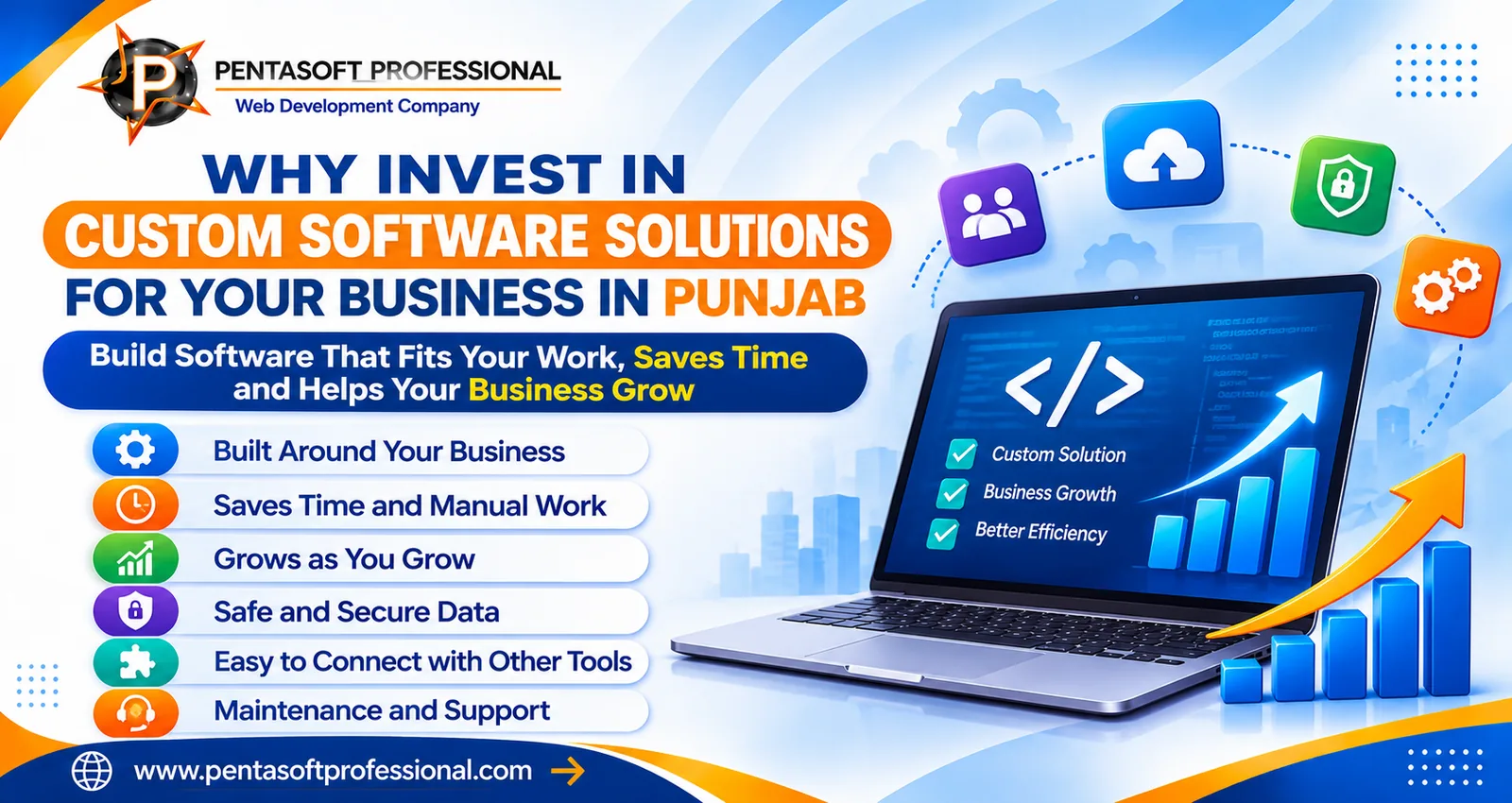
In today's competitive business environment, technology plays an important role in improving productivity, managing operations, and delivering better customer experiences. Businesses of all sizes are adopting digital solutions to simplify their daily activities and achieve long-term growth. However, standard software applications do not always fulfil the unique requirements of every organisation. This is where custom software solutions become valuable.
Custom software is specifically designed to meet the individual needs, goals, and operational requirements of a business. Unlike ready-made applications, it offers flexibility, personalised features, and better control over business processes. Whether you operate a startup, small business, or large organisation, investing in customised software can help improve efficiency and create new growth opportunities.
Let's explore why investing in custom software solutions can be a smart decision for your business.
Have a process you want to automate? Explore our software development services, built around how your business works.
1. Designed According to Your Business Requirements
Every business has different operational processes, customer expectations, and management requirements. Ready-made software generally provides standard features that may not completely match your business operations.
Custom software development focuses on understanding your business requirements before creating a solution. Developers build features according to your specific objectives, making the software more relevant to your daily activities.
For example, an e-commerce company may require advanced inventory management, customer tracking, and automated order processing. Similarly, a healthcare organisation may need appointment scheduling, patient management, and reporting features.
With customised software, you get a solution that works according to your business model instead of changing your entire workflow to match an existing application.
2. Improves Business Productivity and Efficiency
Managing repetitive tasks manually can consume valuable time and increase the chances of human errors. Custom software helps businesses automate various processes, allowing employees to focus on more important responsibilities.
Depending on your requirements, customised applications can automate:
- Customer information management
- Invoice generation and payment tracking
- Employee attendance and performance monitoring
- Inventory and stock management
- Sales reporting and data analysis
- Customer communication and follow-ups
Automation reduces unnecessary manual work and helps teams complete tasks more efficiently. It also improves coordination between different departments.
As a result, businesses can save time, manage resources effectively, and improve overall productivity.
3. Offers Better Scalability for Business Growth
Business requirements change as an organisation grows. A software application that works well for a small business may become insufficient when the company expands its operations, customer base, or workforce.
One of the major advantages of custom software solutions is scalability. These applications can be developed with future business requirements in mind.
For example, if your business initially operates in one location, you may later expand into multiple cities. Your software can be upgraded to support additional branches, users, departments, and business operations.
You can also introduce new features whenever required without depending entirely on the limitations of standard software.
This flexibility makes custom software a practical long-term investment for businesses planning sustainable growth.
4. Enhances Data Security and Business Control
Business data is one of the most valuable assets of any organisation. Customer details, financial information, employee records, and confidential documents must be protected from unauthorised access.
Custom software allows businesses to implement security measures according to their specific requirements.
Depending on the application, these measures may include:
- Role-based access control
- Secure user authentication
- Data encryption
- Regular security updates
- Activity monitoring and audit logs
- Secure database management
- Data backup and recovery systems
Businesses can also decide how their data is stored, accessed, and managed.
Although custom software does not automatically guarantee complete security, a properly designed and maintained application can provide greater control over data protection and security practices.
5. Provides Seamless Integration with Existing Systems
Many businesses use multiple applications to manage different operations, such as accounting, customer relationships, inventory, marketing, and sales.
When these applications do not communicate effectively, employees may need to enter the same information repeatedly. This can create unnecessary work and increase the possibility of errors.
Custom software can be developed to integrate with existing business tools through APIs and other integration methods.
For example, a customised business management system can connect with:
- CRM platforms
- Payment gateways
- Accounting applications
- Inventory management systems
- Email marketing tools
- Third-party business applications
Seamless integration helps create a connected business environment where information can move between different systems more efficiently.
6. Improves Customer Experience
Customer experience has a direct impact on business reputation, customer satisfaction, and long-term relationships. Businesses need reliable digital solutions to understand customer requirements and provide convenient services.
Custom software can help create personalised experiences based on customer behaviour and preferences.
For instance, businesses can develop customer portals, mobile applications, online booking systems, and personalised dashboards. These features allow customers to access services, track orders, manage accounts, and communicate with businesses more conveniently.
A customised application can also help businesses respond to customer queries faster and manage service requests efficiently.
By providing a smoother digital experience, companies can improve customer satisfaction and build stronger customer relationships.
7. Offers Long-Term Cost Benefits
Some businesses avoid custom software development because of its initial investment. Ready-made applications may appear more affordable at first, but their long-term expenses can increase due to subscription charges, additional licences, feature limitations, and third-party integrations.
Custom software requires an initial development investment, but it can offer better long-term value when properly planned.
Businesses can avoid paying for unnecessary features and invest in functionalities that directly support their operations.
Other potential financial benefits include:
- Reduced manual operational costs
- Lower dependency on multiple software subscriptions
- Improved employee productivity
- Fewer workflow-related errors
- Better resource utilisation
- Flexible feature upgrades
The overall return on investment depends on development costs, maintenance requirements, software usage, and business outcomes.
8. Gives Your Business a Competitive Advantage
In a competitive market, businesses need effective ways to differentiate themselves from competitors. Technology can play an important role in achieving this objective.
Custom software allows organisations to introduce features and workflows that are specifically designed around their business strategy.
For example, a retail company can develop a unique product recommendation system, while a logistics business can create customised delivery tracking and route management features.
These specialised functionalities can improve operational performance and help businesses deliver services that better match customer expectations.
Instead of relying on the same standard tools used by competitors, organisations can build technology that supports their unique strengths.
9. Provides Flexibility and Complete Feature Control
Ready-made software generally follows a fixed development structure. Businesses may have limited options when they want to modify certain features or introduce new functionalities.
Custom software provides greater flexibility because the development process is based on your business objectives.
You can decide which features are necessary, how different functions should work, and what improvements should be introduced in the future.
For example, you may initially require basic customer management and reporting features. Later, you can introduce advanced analytics, automated notifications, or additional user permissions.
This level of control helps businesses adapt their technology according to changing market conditions and operational requirements.
10. Supports Digital Transformation
Digital transformation is no longer limited to large enterprises. Small and medium-sized businesses are also adopting digital technologies to improve their operations and remain competitive.
Custom software can support this transformation by replacing outdated manual processes with modern digital systems.
Businesses can use customised applications to manage operations, analyse performance, improve communication, and make data-driven decisions.
However, successful digital transformation requires more than software development. It also involves proper planning, employee training, system maintenance, and continuous improvement.
With the right development strategy, custom software can become an important part of your organisation's digital growth.
Why Choose Pentasoft Professional for Custom Software Solutions?
Choosing the right technology partner is essential when investing in custom software development. A reliable development company understands your business objectives, identifies technical requirements, and builds solutions that support your long-term goals.
Pentasoft Professional focuses on providing technology and software development services that help businesses strengthen their digital presence and improve operational efficiency.
Whether you are planning to develop business management software, a customised web application, or a solution to automate daily operations, working with an experienced development team can help turn your ideas into practical digital products.
Businesses looking for professional custom software development solutions can explore suitable development approaches based on their requirements, budget, and future growth plans.
The right software solution should not only address your current challenges but also provide the flexibility to support your business as it evolves.
Conclusion
Investing in custom software solutions can help businesses improve productivity, automate operations, strengthen data security, and deliver better customer experiences. Unlike standard applications, customised software is designed around specific business requirements and offers greater flexibility for future improvements.
From reducing repetitive tasks to supporting digital transformation, custom software provides several opportunities for businesses to improve their operations and remain competitive.
However, selecting the right development partner and clearly defining your project requirements are essential for achieving successful results.
If your business is planning to improve its operational efficiency and adopt modern technology, exploring custom software development with Pentasoft Professional can be a valuable step towards building a more efficient and scalable business.